
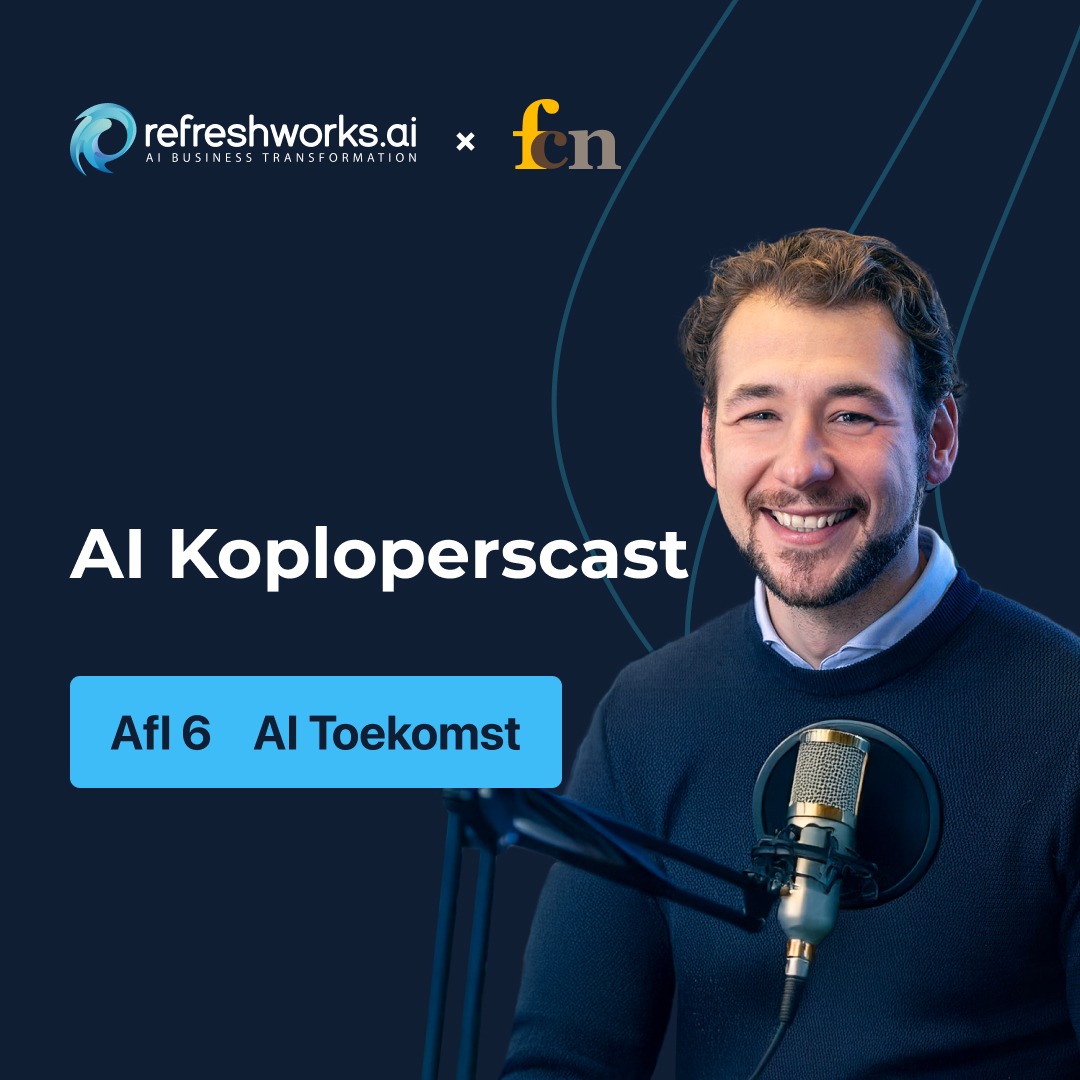
AI is today's reality. But how is the Netherlands actually doing? Do we have the right infrastructure, the right talent, and above all, the right mindset to participate in the AI revolution?
In this final episode of the AI Frontrunners podcast, we speak with Maxime Lubbers, AI Ecosystem Lead at TechLeap, the organization led by Prince Constantijn that helps scale the Dutch tech ecosystem. We dive into recent studies, explore the strengths and weaknesses of the Netherlands, and discuss what entrepreneurs can do now to take the lead.
Where do we stand now as the Netherlands?
Maxime's team examined the Dutch AI landscape from top to bottom. The insights:
Strong foundation
- Digital infrastructure: Almost everyone is online, and the Netherlands scores highly in terms of accessibility and connectivity.
- Talent and universities: Dutch institutions such as TU Delft and the University of Amsterdam train top AI researchers.
But talent leaves
Many of our brightest AI minds end up at OpenAI, Google, or other American giants. Why? Because there they can work on fundamental technology and complex challenges—something that is often lacking in the Netherlands.
Many users, few builders
Around 70% of our AI companies are in the application layer—they build tools on top of existing systems such as OpenAI or Google. Less than 5% build the underlying infrastructure: hardware, vector databases, language models.
This makes us as a country strategically dependent on foreign parties.
What's stopping us?
The study identified four major obstacles:
- Lack of AI literacy
Both entrepreneurs and policymakers often lack a fundamental understanding of AI. Without that insight, no one will get started. - Limited investment capacity and knowledge among investors
Unlike in the US, where bets are placed on 10 startups, Dutch investors are often risk-averse. - Fragmentation of initiatives
The Netherlands has no fewer than seven regional AI hubs – in a country smaller than the state of Virginia. What a waste of economies of scale. - Too little focus on deep tech
To remain relevant, we need to make choices in the AI value chain. Just as we did with ASML in chips, we can also focus on areas such as food, water, health, or education with AI.
What can we learn from other countries?
- United Kingdom: Central AI hub in London, led by a former entrepreneur.
- France: Macron continues with strong leadership and targeted investments.
- United States: One large domestic market, investors with deep pockets and technical knowledge.
Maxime advocates a similar centralized approach in the Netherlands: a single AI hub that brings together talent, infrastructure, and investors.
What can you do as an entrepreneur?
AI is not a project for the IT department. It affects your entire organization. Maxime's advice to entrepreneurs:
1. Immerse yourself – really
Learn the basics: what is generative AI? How does a model work? What is machine learning?
Ask yourself questions such as:
- How was ChatGPT trained?
- What can it do and what can't it do?
- What does this mean for my team?
2. Make your organization AI-literate
From 2025, it will even be mandatory to train employees in AI.
Not only for safety and compliance, but also to ask the right questions and innovate responsibly.
3. Formulate your own frameworks
Don't use AI "because everyone else is doing it," but because it fits with the impact you want to make.
Talk to HR, IT, and your board. Establish principles, such as:
- AI should not make decisions about hiring or firing without human intervention.
- No customer contact without a final human check.
4. Focus on real problems
Look beyond cost savings. Consider:
- Job satisfaction
- Climate impact
- Inclusion
- Accessibility of knowledge
AI is changing everything, including your organization
According to recent research, the following will occur:
- 67% of knowledge jobs are changing,
- 6 to 7% of jobs will disappear.
The question is not whether you should use AI, but how. And above all: for what purpose?
“It's not about AI, it's about leadership.
Form your own opinion. Decide what you stand for. That's AI leadership."
– Maxime Lubbers
Become an AI leader
Want to know exactly where the opportunities lie for the Netherlands and your company? How you, as an entrepreneur, can contribute to a future in which AI works for people and society, and not just for efficiency and profit? Then listen to this inspiring episode with Maxime Lubbers on Spotify.
Although this is the last episode of this series, it is only the beginning of the journey. In this six-part AI Leaders podcast, we have taken you from the basics of AI adoption to agent-based systems, legislation, and now: the vision for the future. Stay curious. Stay critical. And above all: don't get left behind. Become an AI leader.